

AI at B&D
Reflecting B&D’s longstanding leadership on environmental law and litigation, we’re using AI responsibly to improve client service and value in our focused areas of practice.
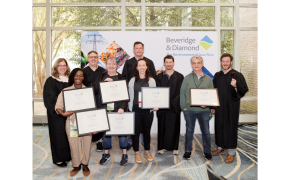
B&D strives to stay one step ahead on artificial intelligence (AI). We have deployed enterprise-grade tools that we use in our work for clients, including secure research and drafting technologies, litigation support tools, and workflow automation capabilities – with a unique focus on our core environmental practice areas. In April 2026 we accelerated our AI deployment by dedicating a significant portion of our all-attorney business retreat to workshopping, with guidance from an AI expert, new and expanded ideas for deploying AI in our areas of practice and in service of our clients’ needs. This “Hackathon” led to nearly two dozen ideas we are currently assessing and queuing for implementation.
Led by our Chief Information Officer David Carns, B&D’s Innovation Delivery Team identifies use cases ripe for AI, pilots AI-supported workflows, and deploys tested solutions for internal and client use.
These tools operate within a governed framework tied to client permissions, confidentiality, and attorney verification.
How Clients Benefit
Our goal when using AI is to improve responsiveness, consistency, and efficiency while preserving the judgment, quality, and accountability clients expect from our lawyers.
For example:
- AI-enabled discovery workflows (analytics, active learning, and AI-enabled coding): Using AI-driven review prioritization and analytics to narrow review populations earlier, accelerate issue spotting, and reduce downstream manual review. On large matters, this supports cost control and improved budgeting.
- Agentic-driven modeling to accelerate review: Applying an adaptive model to surface likely relevant documents earlier in the review cycle, improving early relevance rates, and shortening the timeline to meaningful case insights.
- Privilege workflow enablement: Leveraging structured knowledge and repeatable privilege workflows to improve consistency and reduce rework in privilege determinations. This supports more efficient review and clearer scope control.
- GenAI-enabled drafting and research support (with lawyer oversight): Using enterprise GenAI tools to speed first drafts, synthesize facts, and perform quality-control checks (e.g., citation/factual validation). The result is reduced rework and improved turnaround time for client deliverables.
- Exchange of insights: Sharing perspectives on practical opportunities to deploy AI, informed by our internal pilot projects and our work with clients across industries and departments across the firm. We participate in the L.E.G.A.L. (Leaders Exploring Generative AI in Law) survey and can share our responses with participating companies upon request.
Partnering with Clients on AI
Representative examples of projects where we use AI include:
- Working with a leading technology company to supplement internal AI due diligence for new country-level work, using our own AI tools while also quality checking the company’s AI outputs.
- Analyzing dozens of complex contamination report databases in the context of site cleanups and cost recovery litigation.
- Building a custom AI workflow that preemptively answers hundreds of regulatory questions in draft form for a routine client questionnaire, with our attorneys validating and quality-controlling the output. This pushes low-value work to automation and allows lawyers to focus on high-value activities for the client.
- Using AI-enabled discovery workflows (analytics, active learning, and AI-enabled coding) and AI-driven review prioritization and analytics to narrow litigation review populations earlier, accelerate issue spotting, and reduce downstream manual review—supporting measurable cost control and improved budgeting on large matters.