Washington State Proposes Determinations for 15 Consumer Product Categories
On November 3, 2026, the Washington State Department of Ecology (Ecology) released draft regulatory determinations for 15 consumer product categories as part of its Safer Products for Washington program. The draft determinations identify products for which Ecology proposes chemical restrictions, reporting requirements, or no regulatory action. The regulatory determinations cover a range of consumer products, including architectural paint, artificial turf, cookware, firefighting equipment, insulation, packaging, and motor vehicle tires. Manufacturers and other stakeholders may comment on the draft determinations through December 18, 2026.
Key Takeaways
What Happened: Ecology is proposing regulatory action for 15 priority product categories. Most of the determinations would restrict specified chemicals in the products, while others would impose reporting requirements.
Who's Impacted: Manufacturers, distributors, and retailers of these consumer products.
What You Should Do: Review the draft regulatory determinations and provide comments by December 18, 2026. Consider attending Ecology’s webinar on November 10, 2026.
Background
In 2019, the Washington State Legislature directed Ecology, in consultation with the Washington Department of Health, to implement a regulatory program to reduce chemicals in consumer products (Chapter 70A.350 RCW8). The implementation program is called Safer Products for Washington.
It consists of a four-phase cycle that repeats every five years. First, Ecology identifies "priority chemicals and chemical classes of concern." Second, Ecology identifies "consumer products that are significant sources or uses" of the identified priority chemicals and classes. Third, Ecology determines regulatory action by requiring notice of the use of the priority chemical or restricting its use. Fourth, Ecology adopts rules implementing the appropriate regulatory action.
This draft regulatory determination is part of Phase 3 of the second review cycle of the Safer Products for Washington program. In this phase, Ecology can make one of three regulatory determinations for a chemical-product combination: require chemical reporting, restrict the chemical in a product, or find that no action is currently required. This phase determines whether regulatory action is warranted; enforceable requirements are implemented in Phase 4 rulemaking.
To restrict the chemical in a product, Ecology must find less harmful alternatives that are “feasible and available” and that a restriction is necessary to reduce a significant source or use of a priority chemical, or to protect the health of sensitive populations or sensitive species. If a restriction would reduce a significant source or use of a priority chemical, but no safer, feasible, and available alternatives exist, Ecology may instead require reporting. A determination that no action is currently required means that Ecology has not proposed a reporting requirement or restriction for that chemical-product combination in this cycle.
Ecology’s Draft Regulatory Determinations
Following its identification of priority chemicals and priority products, Ecology proposed the following regulatory determinations for priority chemical-product combinations: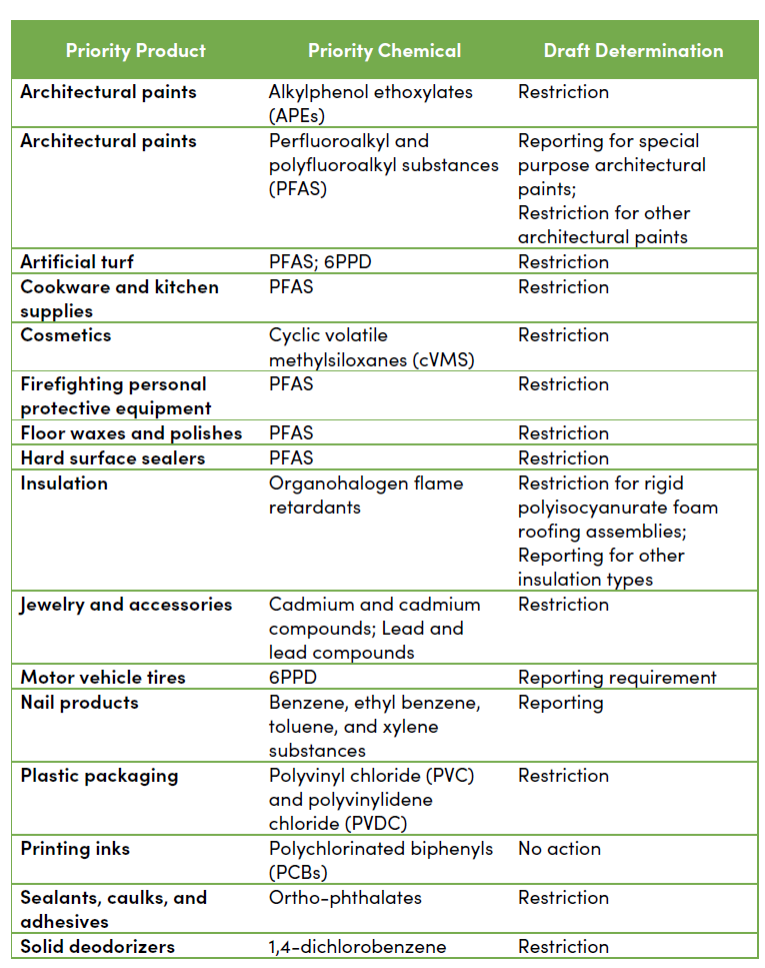
Next Steps
Ecology opened a 45-day public comment period on its draft regulatory determinations that will run from November 3 to December 18, 2026. Ecology will also host a webinar on November 10 to provide an overview of the regulatory determinations and answer questions.
After reviewing public comments, Ecology expects to finalize its regulatory determinations in June 2027. Ecology is expected to release the Phase 4 draft rules implementing its regulatory determinations for public comment in early 2028 and adopt final rules in June 2028.
Product manufacturers and other stakeholders should participate in the comment period to address the scope and feasibility of the proposed regulatory determinations and develop the administrative record before Phase 4 rulemaking.
With an office in Seattle, Beveridge & Diamond helps help identify, understand, and comply with complex regulatory requirements in throughout the product lifecycle. Our lawyers in the Consumer Products and Product Stewardship, Global Supply Chains practices work with U.S. and multinational companies that make, distribute, transport, or sell consumer products in a hyper-competitive and evolving consumer goods market.